
The Dark Side of Adaptability
May 20, 2026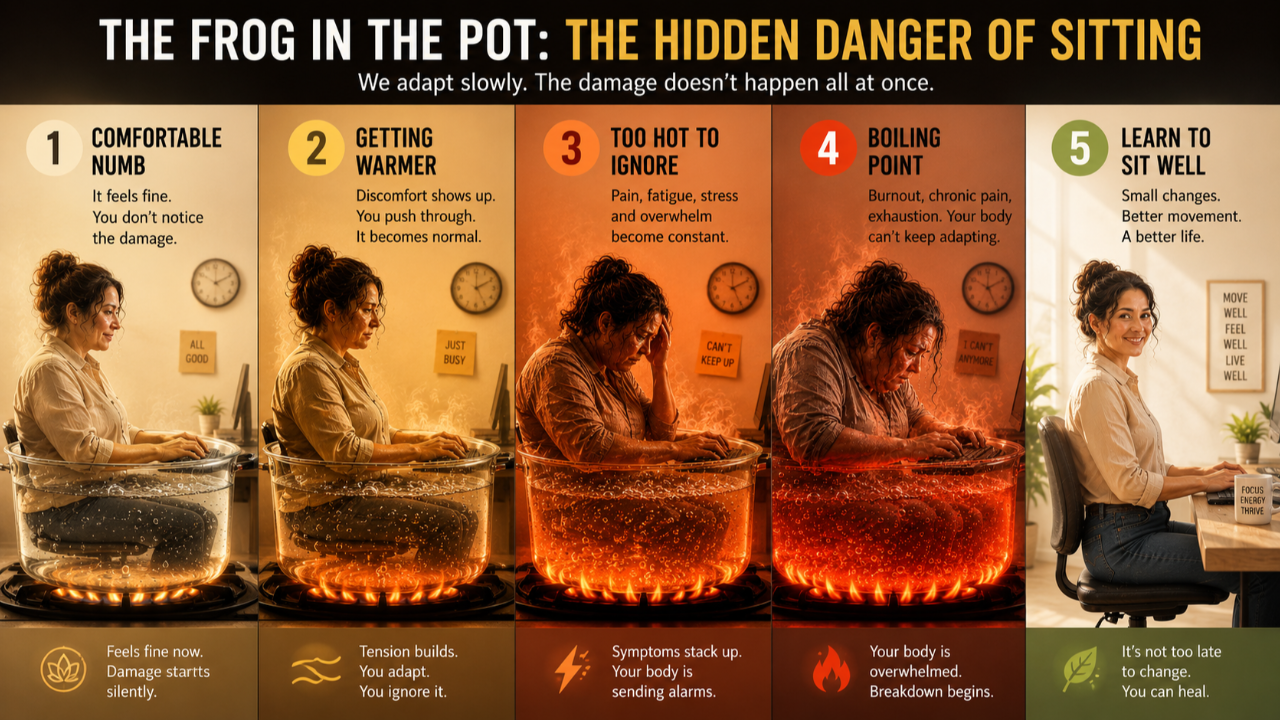
How one of our greatest strengths can quietly undermine our health
The story of the frog in the pot has endured for decades because it captures something fundamentally human.
Whether or not a real frog would remain in gradually warming water is almost beside the point. The metaphor resonates because most of us have experienced some version of it ourselves. We adapt to increasing workloads, mounting stress, persistent fatigue, poor sleep, and physical discomfort without fully noticing the cumulative effect. By the time the problem becomes impossible to ignore, it has often been developing for years.
This capacity to adapt is usually celebrated, and for good reason. It allows us to recover from adversity, navigate uncertainty, and function under challenging circumstances. Yet adaptation has a lesser-known downside: it can make unhealthy conditions feel normal.
That is particularly true in a culture where many people spend the majority of their waking hours sitting.
Adaptation Changes What We Notice
At any given moment, your brain is processing far more information than you could ever consciously perceive. Sensations from muscles, joints, organs, eyes, ears, and skin are constantly competing for attention. To prevent overload, the brain filters. It decides what deserves immediate attention and what can safely remain in the background.
This filtering system is remarkably useful. It allows a surgeon to focus during a long procedure, an athlete to perform under pressure, and a parent to function through a sleepless night.
It also explains why a minor paper cut may seem insignificant during a busy workday yet become strangely irritating once you're home. The injury hasn't changed. Your attention has.
Modern pain science suggests that pain is not simply a signal travelling from tissue to brain. Rather, it is an experience generated by the brain after evaluating a complex mix of sensory information, context, emotion, memory, expectation, and perceived threat. What we notice and what we ignore are influenced by far more than physical inputs alone.
When deadlines, responsibilities, and competing priorities dominate our attention, signals from the body are often pushed lower on the list. The problem is not that the body stops communicating. The problem is that we become increasingly skilled at tuning it out.
When Adaptation Becomes Normalization
Most health challenges associated with modern work don't arrive dramatically.
Prolonged sitting rarely produces a clear moment when something suddenly feels wrong. Instead, the effects accumulate gradually. Breathing becomes a little shallower. The hips lose a bit of mobility. The upper back stiffens. Energy dips become more frequent. Tension settles into the neck and shoulders.
Each change is small enough to accommodate.
The body adapts.
The brain adapts.
Eventually our expectations adapt as well.
What began as an occasional annoyance becomes part of daily life. Afternoon fatigue becomes normal. Headaches become normal. Feeling stiff after a long day becomes normal. Many people begin to describe these experiences as inevitable consequences of age, work, or a busy schedule.
Perhaps they are common. That does not make them normal.
One of the greatest risks of adaptation is that it can blur the distinction between a healthy baseline and a familiar one.
The Challenge of Modern Work
This is where sitting becomes particularly interesting.
Most people already know that movement is good for them. Information is not the problem. We have never had greater access to health advice, fitness programs, podcasts, books, and research.
Yet knowledge alone rarely changes behaviour.
The challenge is that sitting feels deceptively harmless in the moment. Unlike touching a hot stove, the consequences unfold slowly. The body is remarkably accommodating, capable of adapting to long periods of inactivity without immediately demanding change.
Unfortunately, adaptation does not mean immunity.
A growing body of research links prolonged sedentary behaviour with increased risk of cardiovascular disease, insulin resistance, type 2 diabetes, musculoskeletal pain, and reduced overall wellbeing. The body can compensate for quite a while, but compensation is not the same thing as thriving.
The question is not whether sitting affects us.
The question is whether we notice those effects early enough to respond.
How to Check the Water Temperature
Before the body screams, it whispers.
The challenge is that these whispers often arrive disguised as ordinary inconveniences rather than obvious warning signs.
Here are five clues that the temperature in your pot may be rising.
1. You Wake Up Tired Even After Sleeping
Occasional fatigue is part of life. Persistent fatigue is information.
If you routinely wake feeling unrefreshed, reluctant to start the day, or dependent on caffeine just to reach baseline, it may be worth looking beyond sleep quantity alone. Breathing habits, stress levels, movement patterns, and physical recovery all influence how restorative sleep actually feels.
2. By Mid-Afternoon, Your Body Has Collapsed Into Your Chair
You may begin the day sitting relatively upright, only to find yourself several hours later folded toward your screen, shoulders rounded, head drifting forward, and energy fading.
Most people don't consciously notice this transition because it happens gradually. Yet posture and breathing are closely connected. As the body compresses, breathing often becomes less efficient, muscular effort increases, and concentration can become more difficult to sustain.
3. Tension and Headaches Have Become Part of Your Identity
Many people can predict exactly where stress will show up in their body: the neck, shoulders, jaw, or lower back.
The concern is not that discomfort exists. The concern is how often it becomes accepted as a permanent feature of life. Once a symptom becomes familiar, we tend to stop questioning it.
4. Small Changes in Health Seem to Be Creeping In
Perhaps your energy is lower than it was a few years ago. Perhaps you've gained weight despite not changing much else. Perhaps routine activities feel more taxing than they once did.
Health is multifactorial, and no single symptom tells the whole story. However, prolonged inactivity influences metabolic health in ways that are often subtle at first. Small changes accumulated over time deserve attention before they become larger ones.
5. You Know Movement Helps, Yet You Rarely Feel Like Moving
This may be the most revealing sign of all.
Most people already know they feel better after a walk, a stretch, a workout, or time outdoors. Yet physical and mental fatigue often create a feedback loop in which the very thing that would help feels least appealing.
Movement is postponed because energy is low. Energy remains low because movement is postponed.
Breaking that cycle rarely requires heroic effort. More often, it begins with small, consistent interruptions to prolonged sitting before fatigue and stiffness become the default setting.
The Real Skill
The challenge facing modern knowledge workers is not a lack of information. Most people already know they should move more, sit less, sleep better, and manage stress.
The challenge is awareness.
Human beings are extraordinarily adaptable. We can adapt to conditions that nourish us, but we can also adapt to conditions that slowly diminish us. The question is not whether your body is sending signals. The question is whether those signals have become so familiar that you've stopped noticing them.
The body is remarkably adaptable.
That's both the good news and the bad news.
Because if you can adapt your way into dysfunction, you can also adapt your way back to vitality.
Small movement breaks matter. Better breathing matters. Learning how to sit, stand, move, and recover more effectively matters. Not because these actions are dramatic, but because they gently lower the temperature before the water begins to boil.
If adaptability is one of our greatest strengths, perhaps the real skill is knowing when not to adapt.
Ready to Turn Down the Heat?
If you'd like a practical place to begin, download my free guide:
Thrive While Sitting: Three Easy Wins
You'll learn three simple strategies to reduce tension, improve posture, breathe more efficiently, and create more space in your body throughout the workday.
Because the best time to check the water temperature is before it starts to boil.