
Discover Your Diaphragm
Aug 25, 2026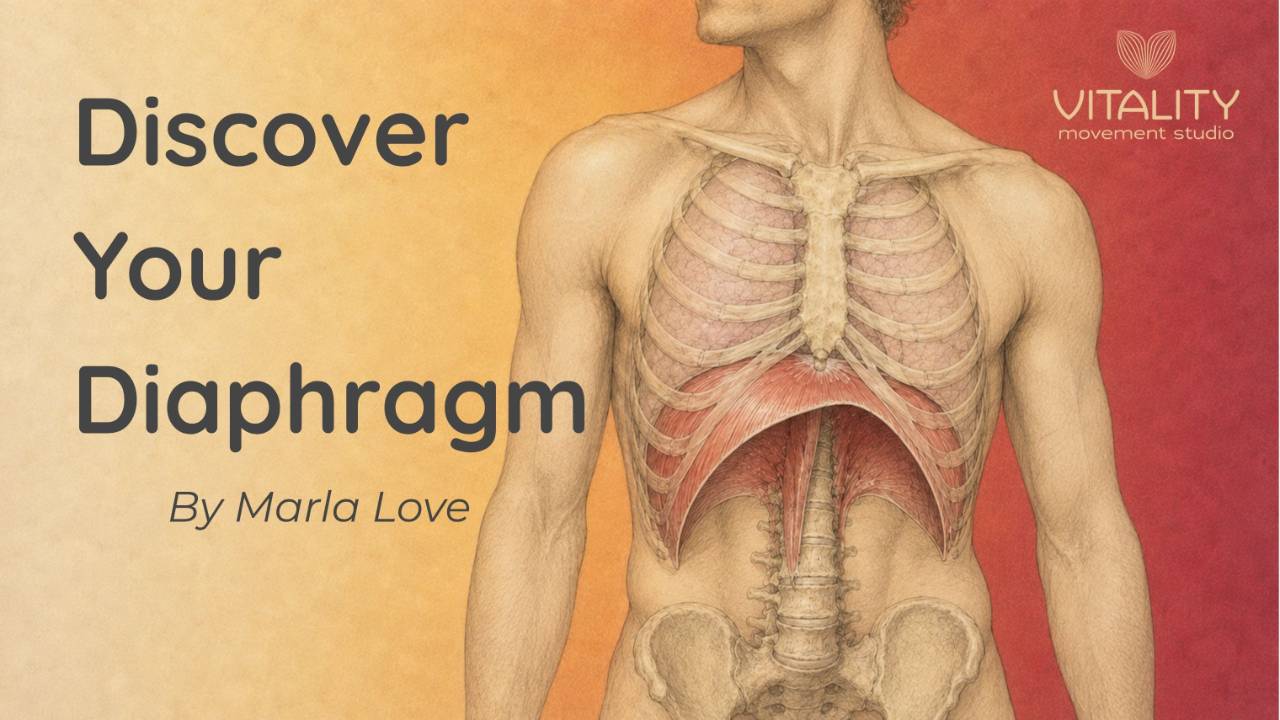
Discover Your Diaphragm
You take approximately 20,000 breaths every day. At the centre of every one is your respiratory diaphragm: a powerful, responsive muscle working continuously to move air, regulate pressure and support the systems that keep you alive and well.
Most people know that the diaphragm is involved in breathing, but they have only the vaguest idea of where it is or how it moves. You may picture a small, flat sheet beneath your lungs that travels up and down like a piston. You may have been told to “breathe into your belly” or “take a diaphragmatic breath” without ever being shown what that actually means.
The real anatomy is far more interesting.
Your diaphragm is a broad, double-domed muscle that reaches from the bottom of your breastbone, around the entire inner circumference of your lower ribs and all the way back to your lumbar spine. It forms the moving boundary between your chest and abdomen.
It is your primary muscle of inhalation, but breathing is only the beginning of its story. Its movement affects the lungs, ribs, spine and abdominal organs. It helps regulate pressure through your centre and works in relationship with the abdominal wall, pelvic floor and deep spinal muscles. Its rhythmic action supports circulation, lymphatic movement, digestion, posture, voice and nervous-system regulation.
The diaphragm is a central pump and a main character in nearly every aspect of your health. Yet few of us have ever learned how to sense it, understand it or work with it.
It is time to discover your diaphragm.
Breathing is a pillar of health
Breathing is one of the seven pillars of health because it both influences and responds to the state of the entire body.
Your breathing changes with movement, sleep, digestion, posture, pain, illness and emotional stress. It speeds up when your body needs more oxygen, but also when you feel rushed, anxious or threatened. It may become shallow when you are in pain, restricted when you brace your body and irregular when your nervous system is struggling to settle.
Your breath is therefore a valuable source of information.
Is your breathing quiet or audible? Easy or effortful? Do you primarily breathe through your nose or mouth? Does your breath move into your lower ribs, or does every inhalation lift your upper chest and shoulders? Can your breathing adapt easily when you change position or begin moving?
When we begin paying attention, the breath reveals habits that may have been operating beneath our awareness for years.
Breathing is also unusual because it is both automatic and partially voluntary. You do not need to remember to breathe, but you can consciously influence the way you breathe.
By releasing unnecessary tension and allowing the breath to become quieter, softer and appropriately slower, you change the information moving between your respiratory, cardiovascular and nervous systems. You encourage a shift away from unnecessary effort and toward regulation, adaptability and homeostasis.
Homeostasis is not a fixed state of perfect calm. It is your body’s ongoing ability to adjust, communicate and return toward balance. A more responsive diaphragm gives this process valuable support.
Where is your diaphragm?
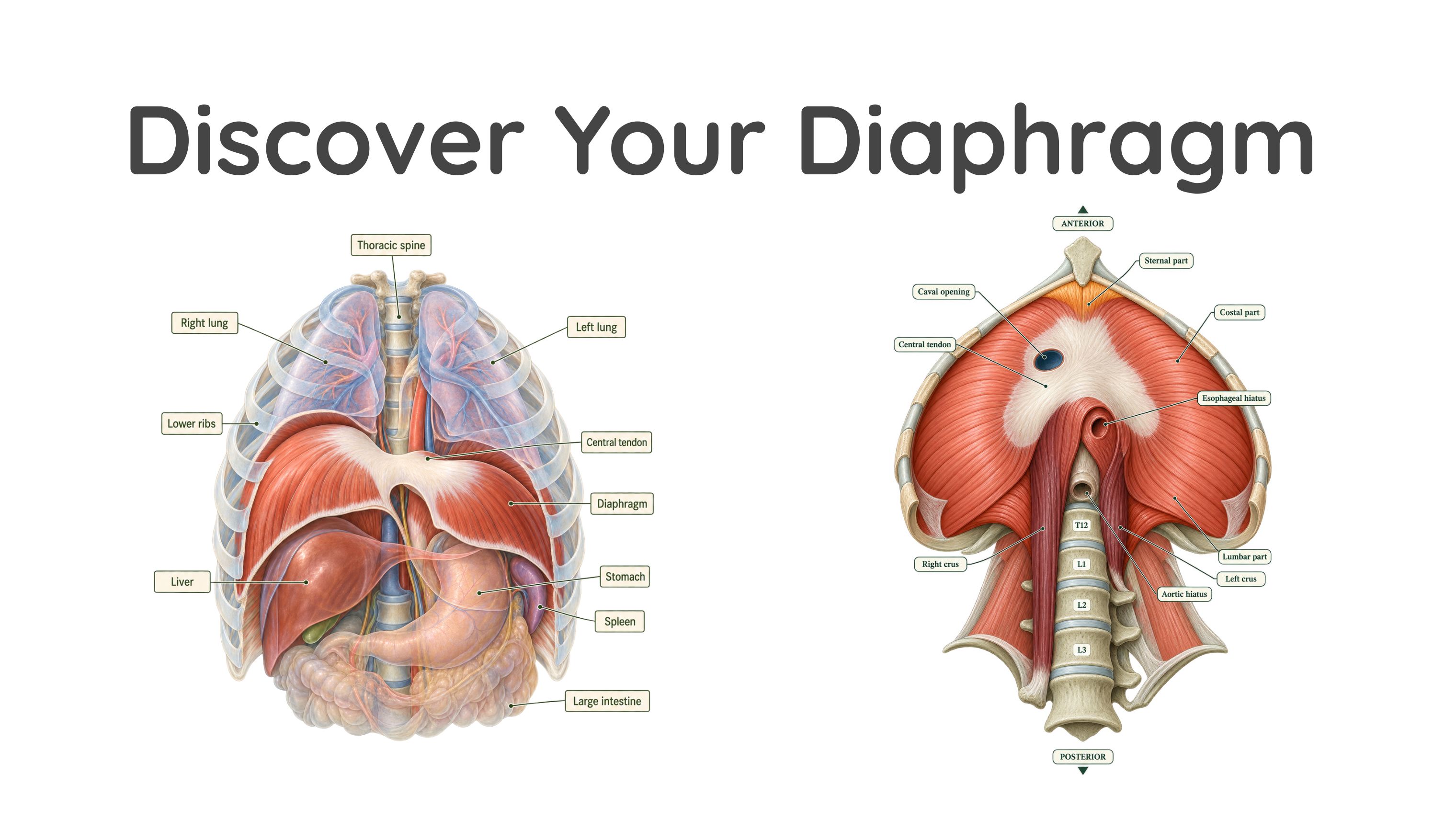
Your diaphragm forms the floor of your chest and the roof of your abdominal cavity. Your lungs and heart sit above it. Your liver, stomach, spleen, kidneys and other abdominal organs sit beneath it.
Rather than being flat, the diaphragm curves upward into two domes. The right dome normally sits slightly higher because of the liver below it. The left dome is shaped by its relationship with the heart, stomach and spleen.
The right and left sides have different neighbours, slightly different attachments and separate phrenic nerves controlling them. Your diaphragm is naturally asymmetrical and three-dimensional.
It is also much larger than most people imagine. It spans the entire lower opening of the rib cage, reaching around your sides and deep into your back.
One muscle with three main parts
The respiratory diaphragm is one continuous musculotendinous structure, but its fibres arise from three main regions: the sternum, lower ribs and lumbar spine.
All these muscular fibres travel inward toward a strong, noncontractile structure called the central tendon. Imagine a double-domed parachute whose muscular panels rise from the perimeter and gather toward the centre.
The sternal part
The small anterior portion of the diaphragm attaches behind the xiphoid process at the bottom of your sternum.
These short fibres connect the front of the diaphragm to the lower breastbone and participate in movement behind the anterior lower ribs and upper abdomen.
The costal part
The costal portion is the broadest region. Its fibres attach around the inner surfaces of the lower six ribs and their costal cartilages.
These fibres form much of the right and left domes. As they contract, they help draw the central tendon downward and contribute to the widening and elevation of the lower ribs.
This is why diaphragmatic breathing is not simply belly breathing. A responsive inhalation creates movement through the front, sides and back of the lower rib cage.
The lumbar part
The posterior diaphragm reaches all the way back to your lumbar spine through two muscular and tendinous columns called the crura.
The longer right crus commonly attaches around L1 to L3. The shorter left crus generally attaches around L1 to L2. These connections involve the vertebral bodies, intervertebral discs and connective tissues at the front of the spine.
The diaphragm also connects through the medial arcuate ligaments, which arch over the psoas muscles, and the lateral arcuate ligaments, which arch over quadratus lumborum. From there, the attachments continue toward the twelfth ribs and around the lower rib cage.
This creates an intimate anatomical conversation between the diaphragm, lower ribs, upper lumbar spine, psoas, quadratus lumborum and abdominal wall.
Breathing and spinal function are not separate subjects. They meet in the very architecture of your body.
Why the spinal attachments matter
The diaphragm needs an adaptable mechanical environment in which to move.
Mobility through the lower ribs, thoracolumbar junction and upper lumbar spine influences that environment. At the same time, the pressure created by the diaphragm helps organize and support the trunk around the spine.
If the lower ribs and upper lumbar region have become rigid, compressed or difficult to sense, the posterior diaphragm may have fewer movement options. Restoring space, awareness and mobility around this region can change how the breath feels and how pressure moves through the body.
This is one reason I include specific ELDOA postures in my diaphragm work. ELDOA uses carefully organized positions to create space and improve proprioception around individual spinal segments. Postures addressing approximately T11 through L3 are particularly relevant because they work with the spinal territory surrounding the diaphragm’s posterior attachments.
[Explore ELDOA postures for the diaphragm’s spinal attachments.]
What happens when you inhale?
When the diaphragm contracts, its muscular fibres shorten and draw the central tendon downward. The domes descend and become less curved, increasing the space inside the chest. The lungs follow this expansion, pressure changes and air flows inward.
As the diaphragm descends, it meets the abdominal organs beneath it. These organs are gently displaced as the abdominal wall and pelvic floor respond to the changing pressure.
Once the central tendon meets resistance from the abdominal contents, continued contraction of the diaphragm contributes to the widening and elevation of the lower ribs.
A responsive inhalation includes movement throughout the entire system:
-
The two domes descend.
-
The lower lungs expand.
-
The lower ribs widen through the front, sides and back.
-
The abdominal contents are gently displaced.
-
The abdominal wall responds.
-
The pelvic floor coordinates with the pressure change.
During a relaxed exhalation, the diaphragm releases, the domes rise and the lungs and rib cage recoil. The abdominal wall and pelvic floor respond again as pressure changes direction.
This is why pushing your belly outward is not the same as using your diaphragm well. The goal is coordinated, three-dimensional movement, not the largest possible abdominal expansion.
The diaphragm also changes its activity according to what you are doing. It breathes while you walk, speak, sing, laugh, lift, cough and change position. It must constantly balance respiratory demand with postural support.
A well-functioning diaphragm is not only strong. It is responsive, mobile and adaptable.
Your central pressure pump
Each movement of the diaphragm changes pressure between your chest and abdomen. This rhythmic pressure exchange helps explain why the diaphragm has such wide-reaching influence.
It supports posture and movement
The diaphragm works with the abdominal wall, pelvic floor and deep spinal muscles to organize pressure through the trunk.
This pressure contributes to spinal support during movement and participates in lifting, coughing, sneezing, speaking, urination and bowel movements.
When the system is coordinated, pressure changes according to the task. You can be supported without gripping every muscle in your centre. You can breathe while you move, and move without constantly holding your breath.
True support is responsive. Your centre needs to organize itself without becoming a concrete bunker.
It supports circulation and lymphatic movement
As the diaphragm descends and rises, it creates alternating pressure changes between the chest and abdomen. These changes assist venous blood returning toward the heart and contribute to lymphatic movement.
The rhythm of your breath moves more than air. It creates an internal pumping action through the centre of your body thousands of times each day.
It participates in digestion
The oesophagus passes through the muscular crural region of the diaphragm. Diaphragm fibres form a supportive sling around this opening and contribute to the barrier that helps prevent stomach contents from travelling back into the oesophagus.
Its relationships with the oesophagus, abdominal organs and pressure system connect diaphragm function with swallowing, reflux, belching, elimination and digestion.
It works with the pelvic floor
The respiratory diaphragm and pelvic floor respond together to changes in abdominal pressure.
As the diaphragm descends during inhalation, the pelvic floor generally yields and lengthens. As the diaphragm rises during exhalation, the pelvic floor recoils. This coordinated movement contributes to continence, pelvic support and efficient pressure management.
It communicates with the nervous system
Your breathing changes immediately in response to effort, emotion and perceived danger.
Under stress, it may become faster, larger, higher in the chest or more irregular. This response is useful when you need to act quickly. It becomes less useful when emergency breathing turns into your everyday setting.
A quiet nasal breath, a softer inhalation and an unforced exhalation provide your nervous system with different information. You are no longer breathing as though you are running from danger while sitting at your desk answering an email.
Improving your relationship with the diaphragm gives you a direct, practical way to influence this conversation.
How diaphragm-aware are you?
Ideally, breathing creates gentle, three-dimensional movement through the lower rib cage: front, sides and back. Like a soft balloon filling, the diaphragm, ribs and abdominal wall respond together, allowing pressure and movement to expand in every direction. The breath should feel quiet, comfortable and adaptable rather than forced or held in one part of the body.
Many breathing patterns are subtle and may feel completely normal simply because you have been breathing that way for years. The following clues may be signs that your diaphragm and breathing could use a little more attention. Learning to notice them gives you a valuable key for improving how you breathe, move and regulate your body.
Begin by noticing:
-
Do you frequently breathe through your mouth?
-
Is your breathing audible while you are resting?
-
Do your upper chest and shoulders lift with each inhalation?
-
Can you feel movement through your lower ribs?
-
Does your breath expand into the side and back ribs, or only forward?
-
Do you frequently sigh, yawn or search for a satisfying breath?
-
Do you hold your breath while concentrating, lifting or exercising?
-
Do you keep your abdominal muscles gripped throughout the day?
-
Does taking a deep breath make you arch your lower back?
-
Does one side of your lower rib cage feel less responsive?
-
Do you feel persistent holding around your lower ribs or upper lumbar spine?
-
Do you shift quickly into heavy mouth breathing during gentle activity?
-
Do you run out of air while speaking?
-
Do reflux, belching, bloating or recurrent hiccups seem to accompany changes in your breathing?
These observations give you a starting point. They are your body’s way of showing you where your breathing may have fewer options and where greater awareness, movement and freedom could be helpful.
If the front of your lower ribs feels rigid, explore the sternal and anterior costal regions.
If your breath moves primarily forward, become curious about the side ribs.
If you feel very little movement through your back ribs, or extend your lower back each time you inhale, explore the posterior costal and lumbar regions.
If one side feels less available, spend time sensing that side without forcing it to match the other.
The goal is not perfect symmetry or an enormous breath. The goal is awareness, choice and adaptability.
Try this diaphragm check-in
Place your hands around your lower rib cage. Let your fingers rest along the sides and your thumbs reach toward your back ribs.
Take several ordinary breaths. Do not try to improve anything yet.
Notice:
-
Can you feel movement beneath both hands?
-
Do your lower ribs widen to the sides?
-
Can you sense movement around your back ribs?
-
Does one side feel different from the other?
-
Does your abdomen yield naturally, or are you pushing it outward?
-
Can you inhale without lifting your shoulders?
-
Can you breathe without arching or stiffening your back?
-
Does your exhalation return naturally, or do you force it?
There is no test to pass. You are building a clearer internal map of a muscle that has been moving inside you since your first breath.
Awareness gives your nervous system information. Once you can sense where movement is available and where it is less accessible, you can begin creating new options.
What could change?
The diaphragm sits at the meeting place of breathing, posture, spinal mobility, digestion, circulation, pelvic-floor function and nervous-system regulation.
When its movement becomes more responsive, the effects may be felt far beyond the breath itself. You may discover greater movement through your ribs, less unnecessary bracing, a quieter resting breath, better coordination during exercise or a stronger sense that your body can settle.
Waking up your diaphragm does not mean forcing it downward or taking bigger and bigger breaths. It means learning where it is, sensing its different regions, releasing unnecessary tension and helping the muscle move according to its design.
This is the foundation of my Wake Up Your Diaphragm mini-course.
We begin by finding the diaphragm. Then we create space around its attachments and restore movement through the ribs and spine. Finally, we integrate that movement into breathing, posture and everyday life.
Your diaphragm is already working for you every minute of every day.
What might change if you learned to work with it?
Marla Love is a movement and breath educator with more than 27 years of experience in yoga, Pilates, ELDOA™, the Franklin Method and breathing education. Through Vitality Movement Studio, she teaches people how to use breath and movement as practical tools for greater health, awareness and vitality.