
The Seven Pillars of Vitality
Aug 29, 2026
The Seven Pillars of Vitality:
Understanding Health, Happiness and Fitness
Healthy, happy and fit.
We often bundle these words together as though they describe one state of being. Marketing has given us a recognizable image to accompany them: a smiling, energetic person with a strong, lean body, an immaculate kitchen and an enviably balanced life.
This image may be easy to identify, but it may have very little connection to our actual lives. It can leave us believing that if we are healthy, we should always feel happy; if we are fit, we must be healthy; and if we do not look or feel the way health has been marketed to us, we must be doing something wrong.
In reality, health, happiness and fitness are three different conversations.
Fitness describes our capacity to meet a particular physical demand. A person may be exceptionally fit for running, cycling, lifting weights or competing in a sport without necessarily being healthy as a whole. Elite athletes can develop extraordinary physical abilities while placing their bodies under tremendous stress and sacrificing rest, relationships and other aspects of well-being in pursuit of performance.
Happiness is part of a rich emotional life, but it is not a permanent state or proof that we are healthy. A healthy life still contains grief, sadness, anger, disappointment and uncertainty.
Fitness can be one expression of health, and happiness can be one experience within it, but neither one defines health on its own.
Health is broader. It includes our capacity to function, adapt, recover and participate meaningfully in life. It is not defined by one physical ability, one perfect diet, one state of mind or one set of numbers.
So, what does it really mean to be healthy?
Understanding What We Need
When my children were very young, I was a single mother and rarely found myself with an afternoon that was entirely my own. When one appeared, I was often so depleted that I did not know what to do with it.
Did I need sleep? A bath? A shower? Fresh air? Time in nature?
Did I need to call a friend and laugh? Did I need to watch a funny movie, or perhaps a sad one and have a good cry? Did I need movement, company, solitude or simply a few hours with no responsibilities?
Most of the time, I chose rest because tiredness was the easiest need to recognize. But I understood that sleep was not always the only thing missing. I could be physically tired while also feeling lonely, emotionally overwhelmed, disconnected from pleasure or starved for something new.
Sometimes we are depleted in so many ways that we can no longer identify what kind of nourishment we need.
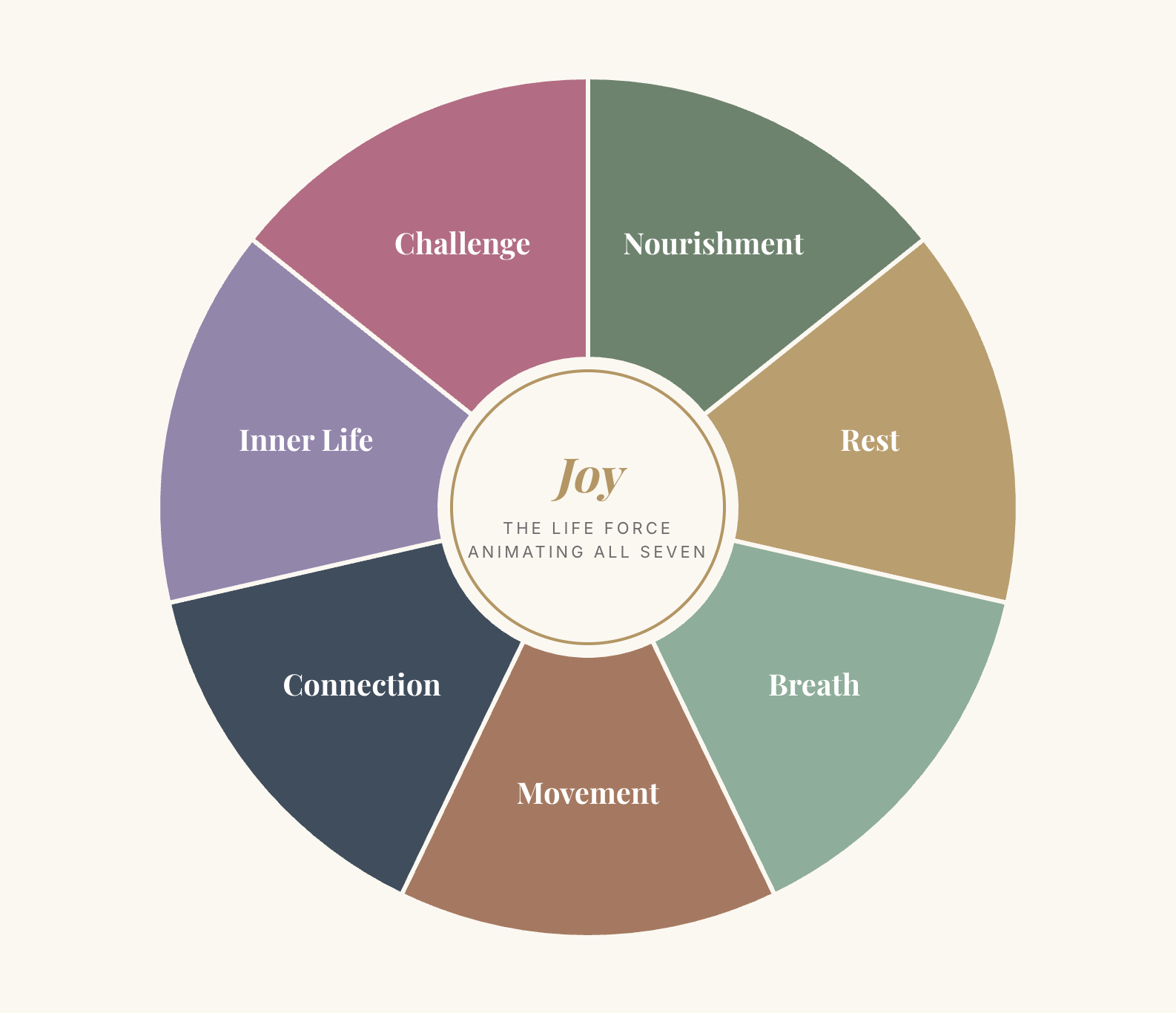
That experience became part of my motivation for thinking about health differently. Rather than treating health as one destination, I began to see it as a living structure supported by seven interconnected pillars.
The Seven Pillars of Health
My seven pillars are:
-
Nourishment - nutrition, hydration and touch
-
Rest - sleep, recovery and downtime
-
Breath - healthy breathing throughout the day and night
-
Movement - physical activity and exercise
-
Connection - community, belonging and relationships
-
Inner Life - emotional and mental well-being
-
Challenge - learning and growth
Like the supports beneath a physical structure, these pillars affect one another. When one is neglected, the others often begin to compensate.
We can live that way for quite a long time. We can rely on discipline when we have not rested. We can use exercise to manage emotional distress. We can remain constantly busy to avoid recognizing our loneliness. The structure may remain standing, but maintaining it gradually requires more effort.
The purpose of these pillars is not to create another standard of perfection. They offer us a way to pause, look at the whole of our lives and notice what is flourishing, what is depleted and what may be asking for our attention.
At times when we feel stuck or tired, simply looking at the pillars may provide a clue. One may catch our attention or remind us of something we have been missing.
And there is something moving through all seven, JOY.
Joy is not an eighth pillar. It is the life force that animates all seven.
1. Nourishment
Nourishment begins with food and water, but the word asks us to consider more than nutritional compliance.
Food provides the physical materials we need to live, repair and produce energy. How we eat and hydrate influences how we feel, think, move and recover. But food also carries pleasure, culture, creativity, memory and connection.
Nourishment might be found in preparing a beautiful meal, tasting something delicious or sitting at a table with people we love. It may also involve the quiet satisfaction of giving our body what it needs, even when no one else sees us doing it.
We are nourished through touch as well. A hug, an affectionate hand, being held or sharing loving or sexual touch can satisfy a deeply human need. Even when sex is not part of our lives, caring physical contact matters. Our need for touch does not disappear because we are single, older or living alone.
There is no single perfect way of nourishing ourselves that suits every person throughout every stage of life. This pillar invites us to consider whether the forms of nourishment available to us are supporting the life we are trying to live.
Inquiry: What kind of nourishment is my body and my life asking for right now?
2. Rest
Rest includes sleep, but it is larger than sleep.
We also need pauses from productivity, responsibility, decision-making and constant stimulation. Rest may involve lying down, sitting quietly, reading, spending time outdoors or doing something simply because it feels pleasant.
Rest does not always mean doing nothing. Sometimes it means doing something that asks very little from us and returns us to ourselves.
Our culture tends to treat rest as a reward for completing everything else. The trouble is that everything else is rarely complete. There is always another message, another task, another bill, another room to clean and another person who needs something.
Without a pause, we can move immediately from one task, experience or stage of life into the next without acknowledging what has occurred. Rest creates space to recognize what we have done, feel what we have experienced and allow it to become part of us.
Rest is a time for integration. It gives us an opportunity to assess, recalibrate and become present again before moving into the next day, the next meeting or the next chapter of our lives.
It can also make room for celebration. Celebration does not always require a party or applause. Sometimes it is simply the moment in which we allow ourselves to say, I did that. It is complete.
Rest is not the opposite of progress. It is part of the rhythm that makes activity sustainable.
Challenge asks the body and mind to adapt. Rest gives that adaptation room to happen. When we continually increase effort without allowing recovery and integration, the activity we call healthy can begin to undermine our health.
There is joy in rest, too: the relief of setting something down and giving ourselves permission to stop, acknowledge and absorb what has occurred before beginning again.
Inquiry: Where might I need a pause to rest, acknowledge or integrate what I have experienced?
3. Breath
Breathing is easily overlooked because it happens automatically. But breath is unusual: it continues without our conscious involvement, yet we can also bring it under our attention and influence.
We do not have to remember to breathe while we sleep. At the same time, we can deliberately soften, slow or change our breathing. Breath lives at the meeting place between what happens consciously and what happens unconsciously.
Our breathing responds continually to our lives. It changes with movement, sleep, emotion, concentration, illness, excitement, laughter, crying and effort. It can reveal something about our inner state before we have found words for what we are experiencing.
When we feel anxious, afraid or overwhelmed, it shows up in our breathing. When we experience comfort or relief, our breathing changes again. Breath reflects what is happening within us.
This relationship also moves in the other direction. Because we can consciously influence our breathing, breath can become a handle for working with our nervous system. When emotion begins to overwhelm us, learning how to work with our breath can help us settle enough to respond more clearly.
We can cultivate a relationship with our breathing and become more sensitive to what it is communicating. We are learning to listen to a rhythm that is already present and discovering how to participate in it.
Like the beating of the heart, breath is one of the body’s powerful underlying rhythms. It is both ordinary and extraordinary: a continuous movement beneath everything else we do.
Inquiry: What can I learn about myself by listening to my breath?
4. Movement
Movement allows us to participate in life.
Walking, reaching, lifting, carrying, bending, climbing, playing and getting up and down from the floor are not merely exercises. They are fundamental expressions of being human.
Through movement, we approach one another, offer a hand, hold, touch, embrace, dance and play. At every age and stage of life, we need a certain physical capacity to interact with the world and with each other. Movement supports our independence, gives us confidence in our physical selves and allows us to take part in the experiences and relationships that give life meaning.
Exercise can develop fitness, but movement is not limited to formal exercise. It includes the hundreds of ways we use our bodies to interact with the world. The appropriate amount and type of physical challenge will be different for each person. Our bodies need enough demand to maintain and develop capacity, along with enough recovery to absorb that demand.
When we are young, much of this challenge may happen naturally through play, exploration and the physical demands of daily life. As we grow older and our routines become more settled, we may need to challenge our physical structure more deliberately.
There is no single answer for everyone. Finding safe and appropriate ways to challenge the body is an individual and evolving practice. Our bodies provide information about what is working, what is too much and what may need more patience or support, but we must learn how to listen.
Too often, people take the stresses and frustrations of life out on their bodies. Movement becomes punishment, and physical challenge is confused with physical abuse. At the other extreme, they may give up and stop moving altogether.
At its best, movement is a conversation with the body. It helps us understand where we feel capable, where we feel restricted and where we may need patience, practice or support.
It is also one of the ways we experience the simple joy of being alive in a human body.
Inquiry: What kind of movement would help me feel capable, connected and alive?
5. Connection
Human beings need connection.
We need belonging, affection and the feeling that someone knows we are here. More than being noticed, we want to be known for who we are. We want to feel seen, understood and ultimately loved.
We also want to offer these things to one another. Connection is reciprocal. We want to know and be known, to care and be cared for, to contribute and to feel that our presence matters.
Connection does not require an enormous social circle. It may be found in a friendship, a family relationship, a class, a neighbourhood, a spiritual community, a shared interest or an act of service.
It can also be found in very small moments: a warm conversation, being greeted by name, laughing with someone who understands our humour or knowing there is a person we can call.
For some people, a small and intimate circle provides a rich sense of belonging. Others feel most alive as part of a larger group or community. The size matters less than the experience of mutual recognition: I know these people, they know me, and I have a place here.
Community can help us feel validated, purposeful and connected to something larger than ourselves. It gives us somewhere to participate and something to contribute to.
Connection also helps us carry experiences that would be much heavier alone. It brings forms of joy that cannot be manufactured in isolation: shared laughter, affection, celebration, conversation and the comfort of being understood.
A person can nourish themselves well, move regularly and appear physically healthy while experiencing profound loneliness. Any meaningful understanding of health must include the quality of our relationships and our sense of belonging.
Connection asks not only, Who is here for me? It also asks, Who am I here to serve?
Inquiry: Where do I feel seen and known, and where can I offer that feeling to someone else?
6. Inner Life
Our inner life includes our thoughts, emotions, memories, fears and desires. It also includes our beliefs, our core values, our connection to our truth and the deeper parts of ourselves that guide what matters to us.
Good health is not a permanent state of calm.
The wellness industry can sometimes leave us feeling that happiness and relaxation are evidence that we are doing everything correctly. When we experience so-called negative emotions such as anger, fear, grief or sadness, we may believe we have done something wrong or wandered off course. We want to move through the feeling quickly and return to being happy and calm.
But a full emotional range is part of a full human life. Our emotions are like music. A meaningful piece does not consist of one pleasant note played indefinitely. It contains different tones, rhythms, tensions, pauses and resolutions. Each contributes something to the whole.
Anger can be an appropriate response to injustice or a crossed boundary. Sadness can be an appropriate response to loss. Fear can alert us to danger or uncertainty. Frustration may tell us that something needs attention. Our emotions give us information, but they do not always give us instructions.
Paying attention to our inner life helps us become more discerning. It can help us recognize what we do not enjoy, what is costing us and what may need to change. It can also show us what brings curiosity, pleasure, meaning and joy.
Of course, life will always include responsibilities and experiences we would not choose. We cannot arrange every moment around what feels good. But we can listen to what our inner life is telling us and make thoughtful choices where choices are available.
Having something to look forward to can be one of those choices. It does not have to be an expensive vacation or a grand adventure. It could be live music, a walk in nature, a class, a visit with a friend or time devoted to something we once loved.
Our inner life speaks through what weighs on us, but it also speaks through what lights us up. Health asks us to learn from both.
Inquiry: What is weighing on me, and what is lighting me up?
7. Challenge
After nearly 30 years of working with older adults, I have come to believe that challenge is an essential and frequently overlooked pillar of health.
Challenge does not have to be extreme, and it does not need to be dangerous. It asks us to move a little beyond what is already easy, familiar or assured. It gives the body, mind and spirit a reason to keep adapting.
Challenge is relative to the individual. It may mean completing a crossword puzzle, learning to cook, changing the way we eat or trying a new activity. It may mean getting down to the floor and standing up again, joining a group where we do not know anyone or preparing ourselves for a particular hike.
A healthy challenge takes us beyond our familiar comfort zone without placing us unnecessarily in danger. Feeling uncertain, awkward or uncomfortable does not automatically mean that something is unsafe. Sometimes it means we are learning.
Often, an appropriate challenge carries two sensations at once. It lights us up with curiosity or excitement while also making us feel just a little nervous. It may ask us to learn something new, go somewhere unfamiliar or discover whether we are capable of more than we realized.
There is a distinctive kind of joy in doing something we have never done before and discovering a new capacity:
I learned something. I went somewhere new. I did not know whether I could do that. Now I know that I can.
Challenge keeps us curious and engaged. It interrupts the sameness of our routines and prevents our world from quietly becoming smaller. However, not every difficult experience is helping us grow.
About ten years ago, I was lying exhausted on a friend’s couch after doing some difficult personal work. I heard myself ask:
Is this the pain of growth, or is this the pain of banging my head against a wall?
Sometimes we do not know. The pain of growth and the pain of repeated depletion can both involve discomfort, effort, fear and frustration. Our inner life gives us somewhere to listen and observe.
Is this experience gradually developing our capacity and making our world larger? Or is it repeatedly draining us, keeping us trapped and making our lives smaller?
Embracing challenge asks us not to retreat from every discomfort. Our inner life asks us not to mistake every discomfort for growth.
Inquiry: What new possibility lights me up and makes me just a little nervous?
Health as a Living Practice
The goal is not to achieve perfect balance among all seven pillars. Different seasons of life require different things from us. Grief, illness, parenting, financial pressure, caregiving, work and major transitions can temporarily draw our energy toward one area and away from another.
This framework is not intended to become another way to judge ourselves. It offers us a playful and compassionate way to become curious:
-
What is supporting me well right now?
-
Where am I depleted?
-
What am I using to compensate for something else?
-
Which pillar is asking for more attention?
-
What have I stopped doing that once brought me joy?
-
What small bright spot could I place on the horizon?
Sometimes we do need sleep. Sometimes we need movement, laughter, solitude, touch, a nourishing meal, a meaningful conversation or the fresh energy of doing something new.
The more clearly we recognize what we need, the more deliberately we can care for the whole of ourselves and our lives.
Coming Soon…
Soon, I will be sharing a Vitality Assessment designed to help you recognize which pillars are flourishing, which may be depleted and what might help you feel more fully alive.